PaperAtlas

PaperAtlas is an atlas of the computational methods and software described in the open-access biomedical literature, built in a single automated pass over the PubMed Central full-text archive.

By the numbers

Articles screened6,446,741
Papers where computation is a central result1,074,191
Schema-valid structured records1,074,140
Clusters in the atlas1,000
Papers in the atlas165,432
Distinct extracted name strings121,844
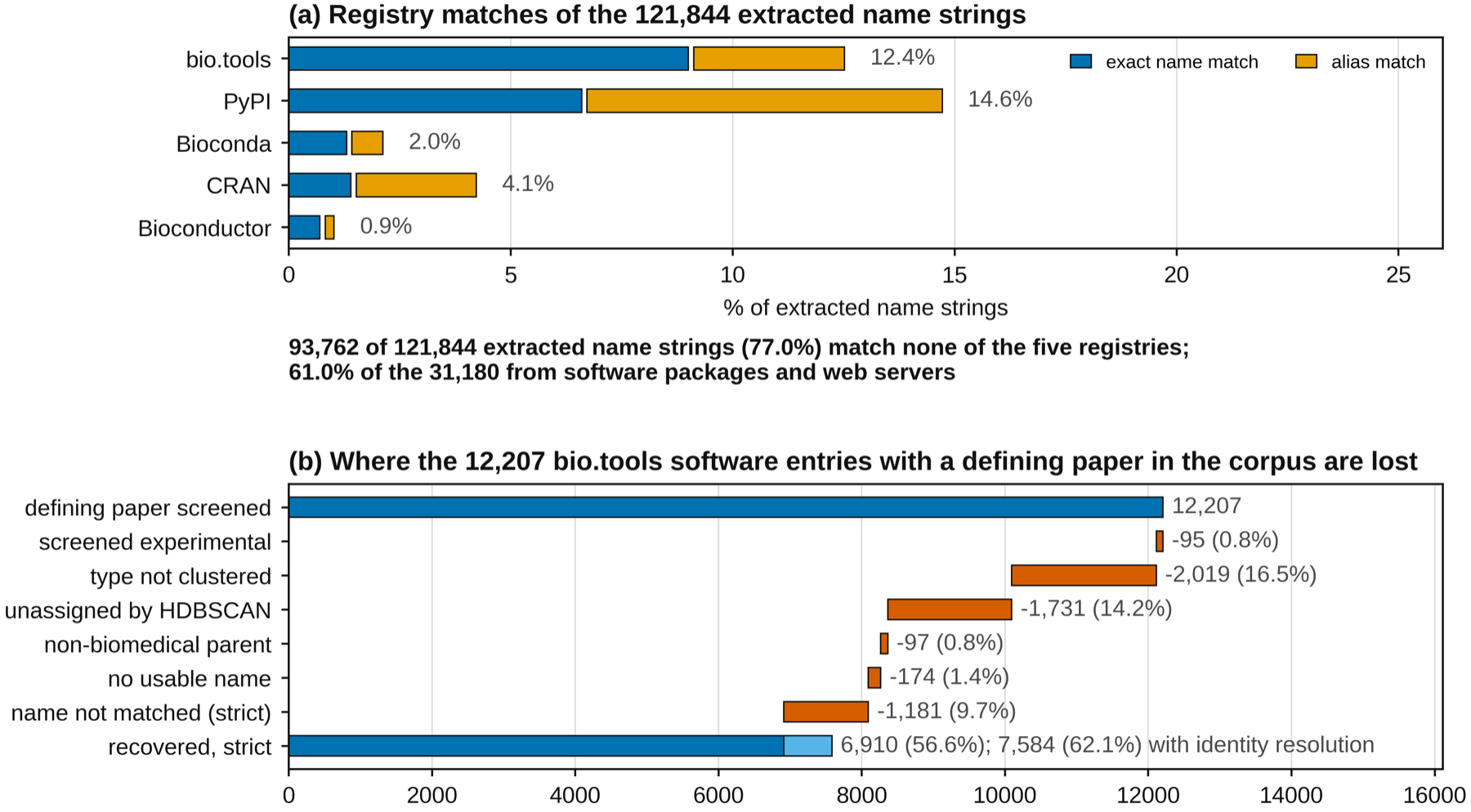
Of those, with no strict name match in bio.tools, PyPI, CRAN, Bioconductor or Bioconda93,762 (77.0%)
Name strings from software package and web server papers with no strict match19,031 (61.0% of 31,180)
Distinct dataset accessions285,615
Distinct Git repository links77,382

The atlas is free to browse. The published files are the September 2026 release, the version described in the manuscript. Releases are versioned by date and earlier releases are kept.
How it is built

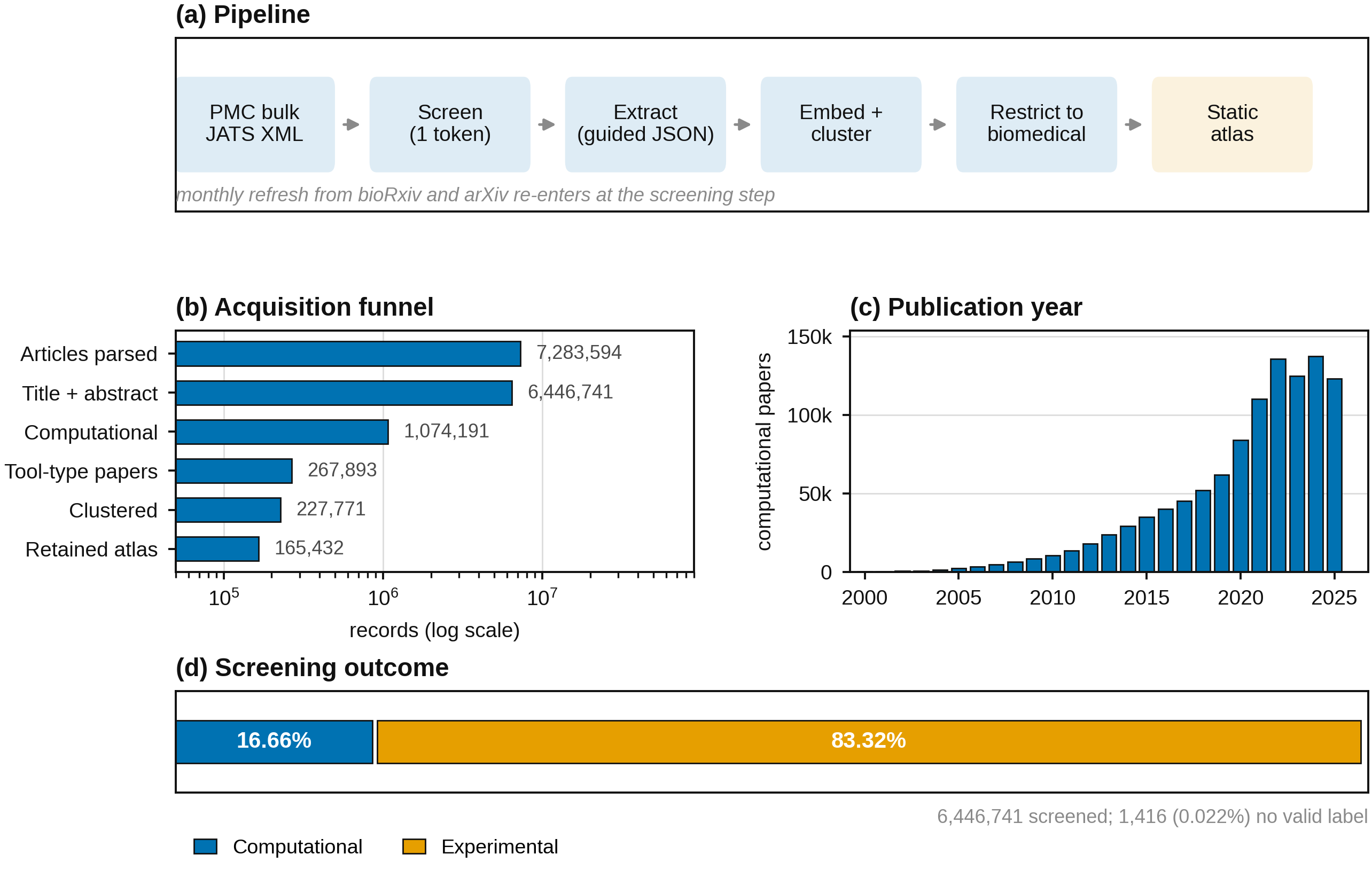
Figure 1: the PaperAtlas pipeline and corpus — end-to-end workflow, acquisition and screening funnel from 7,283,594 articles parsed to 165,432 retained, publication-year distribution of the computational corpus, and screening outcome.
Figure 1. The PaperAtlas pipeline and corpus. (a) End-to-end workflow. (b) Acquisition and screening funnel, 7,283,594 articles parsed to 165,432 retained under the parent-level biomedical rule. (c) Publication year of the computational corpus. (d) Screening outcome.
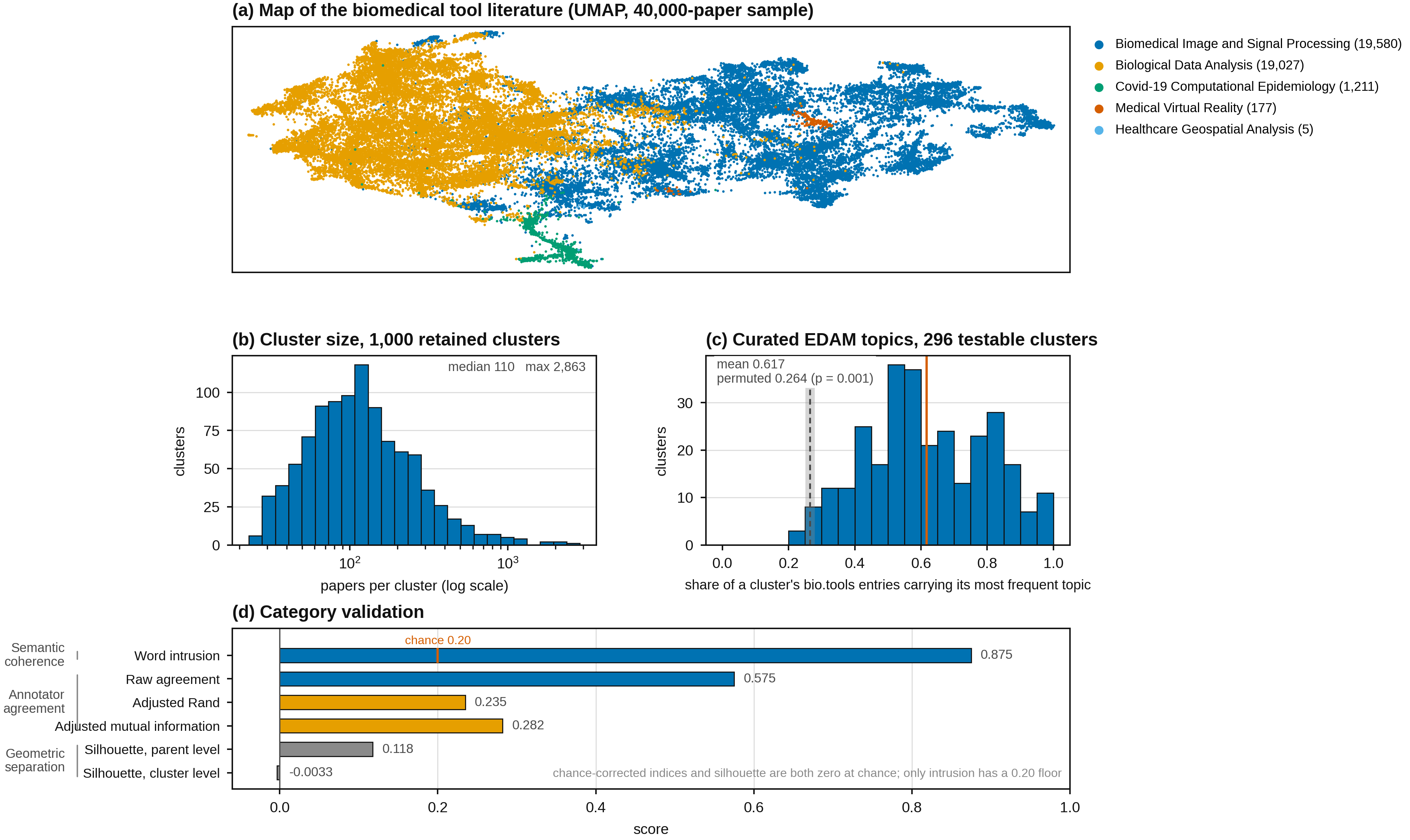
Figure 2: the atlas and its validation — UMAP of retained tool-type paper embeddings coloured by parent topic, cluster-size distribution across 1,000 clusters, curated EDAM topic concentration for 296 testable clusters, and label-free validation measures.
Figure 2. The atlas and its validation. (a) UMAP of the retained tool-type paper embeddings, coloured by parent topic, a navigational grouping. (b) Cluster sizes across the 1,000 retained clusters. (c) For the 296 clusters with at least five linked bio.tools entries, the share of entries carrying the cluster's most frequent curated EDAM topic: mean 61.7%, against 26.4% under 1,000 label permutations (p = 0.001). (d) Validation measures, grouped by the property each tests; none uses human labels.
Figure 3: registry matching and bio.tools recall — exact and alias match rates of the 121,844 extracted name strings against five registries, and a stage-by-stage account of where the 12,207 bio.tools software entries with a defining paper in the corpus are lost.
Figure 3. Registry matching and bio.tools recall. (a) Exact and alias match rates of the 121,844 extracted name strings against the five evaluated registries; 93,762 (77.0%) match none, and 61.0% of the 31,180 names from software-package and web-server papers have no strict match. (b) Where the 12,207 bio.tools software entries with a defining paper in the corpus are lost, stage by stage: 56.6% are recovered by strict matching, rising to 62.1% with identity resolution, the largest losses being entries whose type is not clustered (16.5%) or left unassigned by HDBSCAN (14.2%).

Citation

Shah N, Vippagunta A, Bhargava Y. PaperAtlas: an automatically constructed atlas of computational methods and software from 6.4 million open-access articles. arXiv:2609.28275 [cs.DL]. 2026. https://arxiv.org/abs/2609.28275